Napoleon's Infantry Handbook by Terry Crowdy
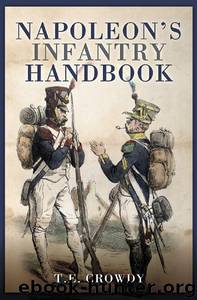
Author:Terry Crowdy [Crowdy, Terry]
Language: eng
Format: epub
Tags: HISTORY / Modern / 19th Century
ISBN: 9781473852327
Publisher: Pen and Sword
Published: 2015-01-30T00:00:00+00:00
For example, if there were three vacancies, the first would go to the most senior candidate; the second would be elected and the third chosen by the government from a list of nominees provided by the regiment. Napoleon was not a great supporter of the election system and considered it unjust and discouraging. All too often good, steady officers were overlooked for promotion in favour of fast-talking demagogues. Equally, the process of nomination to the government was open to abuse, particularly if the colonel had a favourite he wished to advance.
Napoleon limited the scope for abuse, stipulating the candidates must have served for at least four years in their present grade before being considered. This put a halt to the sort of rapid promotions which had occurred in the 1790s. If the colonel could not find a suitable candidate the emperor would choose another candidate from a regiment in the same arm with the required experience. In turn, sub-lieutenancies would only be awarded to sub-officers of at least six years’ service, four of which was in their current grade (this was raised to eight years in 1811), or to graduates of military school. They would remain sub-lieutenants for at least four years. Candidates for the rank of captain would require eight years’ service, including four as lieutenant; battalion commanders would require eight years’ service as captains. Officers proposed for the rank of major or colonel would only receive their brevets after having commanded parade manoeuvres in front of the emperor.
Newly appointed officers received a brevet which was a formal commission of employment. Under Louis XV the brevet only applied to the likes of an aide major, chaplain and major. Lieutenants and sub-lieutenants received lettres and captains and senior officers received commissions (generals received a patente). These documents were issued as a certificate in gothic script, but after the Revolution came on simple paper. The date on the brevet was used to determine seniority between officers of an equal rank. As a sign they had received the brevet, officers wore a gilded gorget (hausse col) when they were on duty – a symbolic representation of the armour previously worn by knights.
There was another route for promotion open to officers, particularly those who were highly educated, or came from a family of influence. This was to secure an attachment to the staff of a general as an adjunct (adjoint) or ordinance officer (officier d’ordonnance), running messages, carrying out office duties, transcribing orders, and generally being useful. Very often these positions were secured, directly or not, through nepotistic means. Initially the officer might be retained on the books of his parent regiment (a so called supernumerary, or officier à la suite); but some were then made full time aide de camp to a general. From that point onwards, the officer would enjoy better conditions, would move in higher circles and, if he proved himself useful (and lucky), his general would ensure he was mentioned in despatches and secure what promotion he could.
All soldiers might also be promoted on the battlefield.
Download
This site does not store any files on its server. We only index and link to content provided by other sites. Please contact the content providers to delete copyright contents if any and email us, we'll remove relevant links or contents immediately.
| Africa | Americas |
| Arctic & Antarctica | Asia |
| Australia & Oceania | Europe |
| Middle East | Russia |
| United States | World |
| Ancient Civilizations | Military |
| Historical Study & Educational Resources |
The Radium Girls by Kate Moore(12035)
100 Deadly Skills by Clint Emerson(4931)
Rise and Kill First by Ronen Bergman(4797)
The Templars by Dan Jones(4695)
The Doomsday Machine by Daniel Ellsberg(4493)
The Rape of Nanking by Iris Chang(4224)
Killing England by Bill O'Reilly(4008)
Stalin by Stephen Kotkin(3973)
Hitler in Los Angeles by Steven J. Ross(3949)
12 Strong by Doug Stanton(3554)
Hitler's Monsters by Eric Kurlander(3348)
Blood and Sand by Alex Von Tunzelmann(3207)
The Code Book by Simon Singh(3197)
Darkest Hour by Anthony McCarten(3135)
The Art of War Visualized by Jessica Hagy(3014)
Hitler's Flying Saucers: A Guide to German Flying Discs of the Second World War by Stevens Henry(2758)
Babylon's Ark by Lawrence Anthony(2685)
The Second World Wars by Victor Davis Hanson(2529)
Tobruk by Peter Fitzsimons(2521)
